Industry news and background information.
What Is ESD Protection? Electrostatic Discharge in Packaging
ESD (Electrostatic Discharge) is the sudden flow of electricity between two objects with different electrical charges. In electronics manufacturing, an ESD event of just 100 volts can destroy a MOSFET — yet a person walking on carpet can build up 25,000 volts. ESD-protective packaging prevents accumulated static charges from reaching sensitive components.
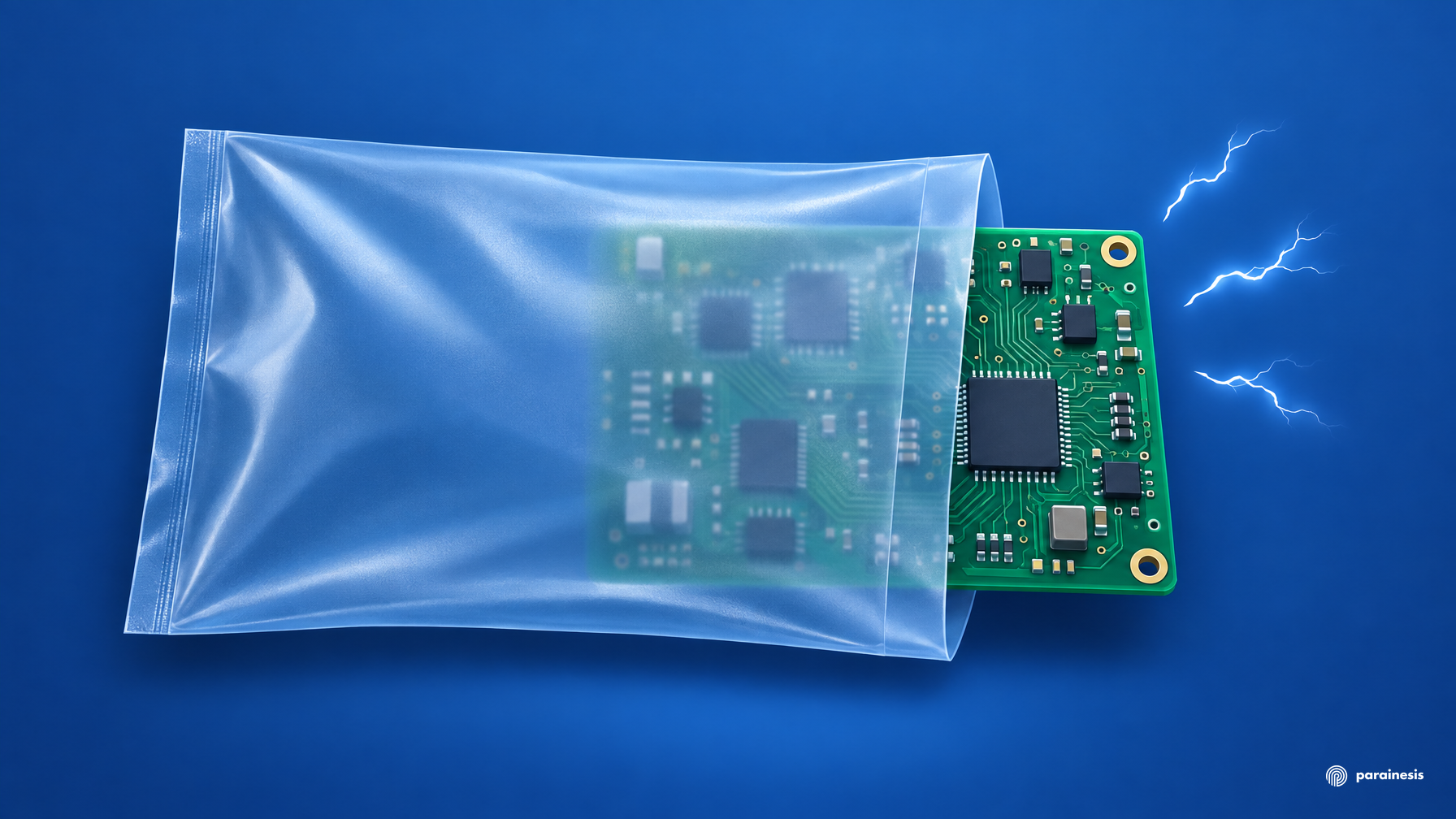
ESD (Electrostatic Discharge) is the sudden flow of electricity between two objects with different electrical charges. In electronics manufacturing, an ESD event of just 100 volts can destroy a MOSFET — yet a person walking on carpet can build up 25,000 volts. ESD-protective packaging prevents accumulated static charges from reaching sensitive components.
ESD Protection Levels
| Level | Surface Resistance | Function | Typical Color |
|---|---|---|---|
| Insulative (standard PE) | >10¹³ Ω | No ESD protection — charges accumulate | Transparent |
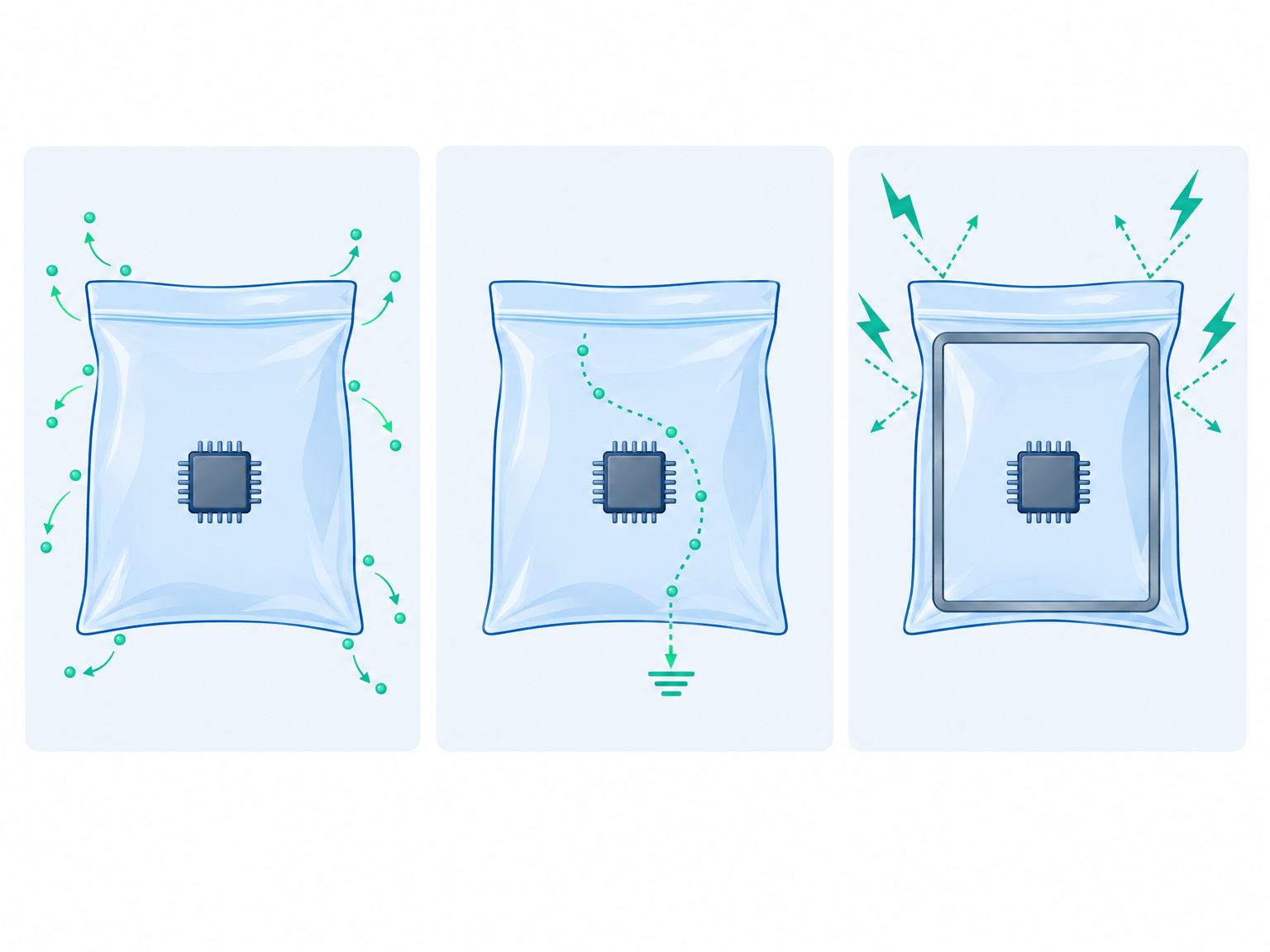
| Antistatic | 10¹⁰–10¹³ Ω | Reduces charge buildup on the film surface | Pink/transparent |
| ESD dissipative | 10⁹–10¹² Ω | Drains charges slowly and safely | Transparent/printed |
| ESD shielding | <10⁹ Ω + metal layer | Blocks external fields (Faraday cage effect) | Silver/grey |
Critical distinction: Antistatic and ESD-protective are not the same thing. Antistatic film only prevents the film itself from charging up. ESD-dissipative film actively drains charges away from the packaged component in a controlled manner.
Component Sensitivity
| Component | Sensitivity (HBM) | Required Protection |
|---|---|---|
| MOSFET, JFET | 100–200 V | Shielding or dissipative |
| ICs, microprocessors | 200–500 V | Dissipative or shielding |
| Populated PCBs | 200–1000 V | Dissipative |
| LEDs | 500–2000 V | Antistatic or dissipative |
| Resistors, capacitors | 1000–3000 V | Antistatic |
| Connectors, cables | >3000 V | Standard or antistatic |
How ESD Additives Work in PE Film
| Method | Mechanism | Duration |
|---|---|---|
| Internal additive | Migrates to the film surface, absorbs moisture → forms conductive layer | Long-term (migrates continuously) |
| External coating | Applied to the surface after production | Short-term (wears off) |
| Conductive filler | Carbon black or metallic particles throughout the film | Permanent |
Parainesis uses internal additives for antistatic and dissipative film, and conductive fillers for shielding applications.
ESD Packaging Standards
| Standard | Scope |
|---|---|
| EN 61340-5-1 | Protection of electronic devices from ESD — general requirements |
| EN 61340-5-3 | ESD packaging requirements — materials and test methods |
| ANSI/ESD S541 | ESD packaging standard (US) |
| IEC 61340-2-3 | Test method for surface resistance |
ESD Film Products
| Product | Description |
|---|---|
| ESD flat film | Sheets and rolls for wrapping, interleaving |
| ESD film tubing | Tubing for custom bags (cut and seal) |
| ESD bags | Pre-made bags (open-top, zip-lock, sealed) |
| ESD pallet covers | Full pallet protection for electronics pallets |
| ESD stretch film | Pallet wrapping with ESD properties |
Parainesis ESD Film
- Antistatic (10¹⁰–10¹³ Ω) — Internal additive, long-lasting
- Dissipative (10⁹–10¹² Ω) — For sensitive components
- All formats — Flat film, tubing, bags, pallet covers
- 3-layer co-extrusion — ESD layer where needed, standard layers elsewhere
- Cleanroom production — ISO Class 9 for pharma/electronics
- Standards — EN 61340, ANSI/ESD S541 compliant